
Ernest Adjei: The Rise of Space Cybersecurity Talent
At THE SIGN.MEDIA, our mission is to support and highlight emerging talents shaping the future of space cybersecurity. Thanks to our dear friend William Ferguson, the architect of the EU Space Cybersecurity Hackathon (the first edition held in Madrid in October 2025), we discovered the inspiring story of Ernest Adjei.
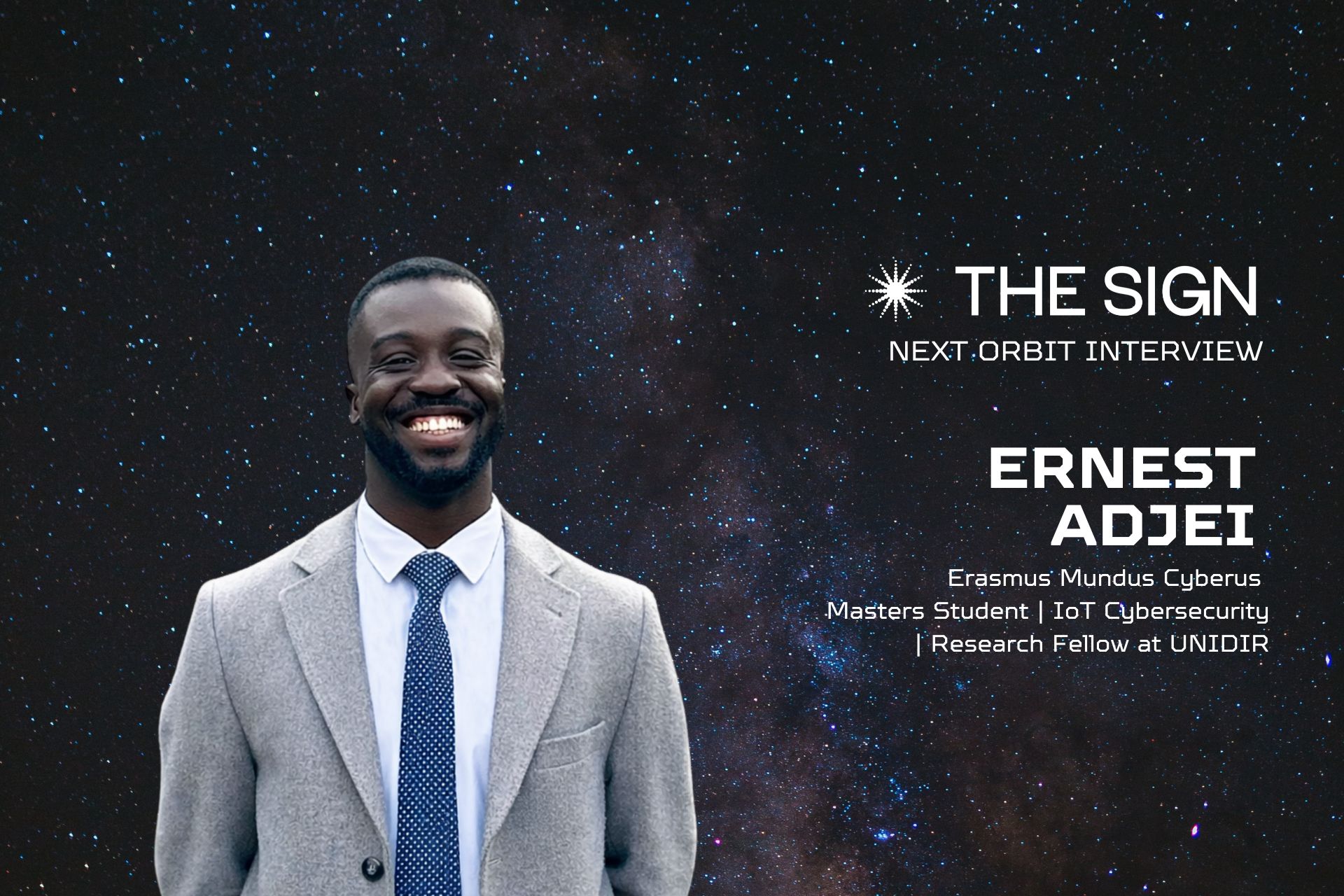
From humble beginnings as a STEM student in Ghana, Ernest has carved an extraordinary path, one that has led him to become one of just ten research fellows selected globally for the first edition of the United Nations Institute for Disarmament Research (UNIDIR) Space Security Fellowship.
In this conversation, Tatiana Skydan explores Ernest's background, motivation and commitment to advancing cybersecurity in the space domain. Ernest is taking on one of the critical challenges of our time: the need to integrate aerial, maritime and space systems into a unified cybersecurity framework, an essential step toward building a more secure and resilient future.
The Spark: Discovering Cybersecurity
THE SIGN: How all this jazz started for you?
E.A.: I started with a bachelor's degree in Computer Science and Engineering from the University of Mines and Technology, Ghana, where I'm originally from. After graduating, I worked for some time in Ghana before applying to the Erasmus Mundus CYBERUS double master's program in cybersecurity.
That opportunity brought me to Europe in September 2024, where I began my studies in France. The program spans two years and involves multiple universities across Europe. What makes it unique is that, beyond the technical aspects of cybersecurity, it also exposes you to how culture, policy, and regional perspectives shape the cyber domain. I started in France, continued in Estonia, and then returned to France to complete my first year.
During that first year, I was introduced to the space domain through training with ethicallyHackingspace (eHs), specifically the Space, Cybersecurity, Operations, and Resilience (SCOR) program led by William. Before that, my focus had been on cybersecurity, but this experience opened my eyes to how cybersecurity applies within the space sector.
The intersection between cyber and space is really interesting because they are very different fields. For example, during one of our training sessions, I was struck by how natural phenomena like solar radiation can introduce vulnerabilities and even create conditions that adversaries could exploit to compromise space systems. That really stood out to me, and understanding how these areas connect has since become a key part of my journey.
In May 2025, I had my first major opportunity to present my work at CYSAT in Paris, through eHs. I presented at the Innovation Corner, focusing on the use of satellite-connected drones for search and rescue operations. My research testbed was based in the Canary Islands in Spain, where tourists sometimes get lost in mountainous areas. One of the key challenges is the delay in coordination during rescue operations. I explored how integrating drones with satellite communication could reduce response times and improve the chances of finding missing persons alive.
Following that experience, I continued working with eHs through an internship while beginning the second year of my master's program in Brussels in September 2025.
During this time, I had more opportunities to present my work internationally. In October 2025, I presented at the Denmark Space Conference, and shortly after, I was invited to the Greece Open Source CubeSat Workshop. There, I expanded my research to include maritime applications, exploring how satellite-connected drones could support operations at sea.
In January 2026, I was selected as one of the "Young Voices" at the European Space Conference in Brussels, Belgium. It was a great opportunity to bring a youth perspective into discussions with policymakers and leaders in the European space sector, especially on security and resilience challenges in space-enabled systems.
More recently, in March 2026, I joined Marble Imaging, an earth observation company based in Bremen, Germany, where I am currently completing my master's thesis internship. My work focuses on detecting shifting risk profiles in BSI-compliant satellite ground stations.
Also in March 2026, I was selected as one of ten participants globally for the inaugural research fellowship at the United Nations Institute for Disarmament Research (UNIDIR), focused on space security. This opportunity places me at the heart of multilateral discussions on space governance, where I translate technical vulnerabilities into diplomatic frameworks and risk-reduction strategies.
THE SIGN: Impressive journey! Can you recall your interests in school years? Were you a STEM student, curious about math and physics? Where does your interest come from?
E.A: I was born and raised in Takoradi, in the Western Region of Ghana. We speak Fante, and I spent most of my schooling years there before moving to Tarkwa for university.
When it comes to how I got into science and technology, I think my older brother played a big role in shaping my perspective. Growing up, he was really interested in medicine and always talked about becoming a doctor, so I was exposed to a lot of science-related ideas early on.
But I realized pretty quickly that medicine was not for me. I was more drawn to mathematics and science in general. I just enjoyed understanding how things work.
In senior high school, I attended Ghana Senior Technical School (GSTS). My electives were biology, physics, chemistry, and elective mathematics. I found all of them interesting, but physics stood out the most for me. I feel it is connected to mathematics, but it also challenges you to think differently and really understand the principles behind things.
That curiosity pushed me to take my studies more seriously. In my third year, I was selected to be a member of the team to represent my school in the National Science and Maths Quiz, which is a major academic competition in Ghana. It brings together top students from different senior high schools to compete at the national level in science and mathematics.
Being part of that experience was a big moment for me. Looking back, I would say that is where my passion for STEM really took shape. From there, it naturally led me to study computer science and engineering at the university level.
THE SIGN: Who among your professors impacted you the most?
E.A.: In my third year at university, I had a visiting professor from Nigeria, Professor Boniface Kayode Alese. He taught Information Security, and that was actually my first time being introduced to the subject. I still remember his first lecture. The way he explained the subject immediately caught my attention. It was clear, practical, and very engaging. After that class, I went up to him and told him how interesting I found the topic and that I wanted to learn more.
He was very supportive. He shared additional materials with me, and I ended up performing really well in his course. But more importantly, that was the moment my interest in cybersecurity really started to take shape. Even after I graduated, we stayed in touch. When I later applied for the Erasmus Mundus cybersecurity program, he was kind enough to write me a recommendation.
So I would say he has had a lasting impact on my journey. He is currently a professor of cybersecurity at the Federal University of Technology, Akure in Nigeria, and he is very passionate about sharing knowledge, especially with young people. He also speaks at a lot of conferences and makes cybersecurity feel very practical and accessible.
Systems Converge: The New Frontier of Cybersecurity
THE SIGN: From the perspective of the network you are already building, being involved in many European and global programs, how do you understand interconnectivity across institutions and regions? How would you describe the biggest issue in space cybersecurity today? And how is the situation in Africa? Would you like to contribute to making it stronger and more resilient?
E.A.: From what I've seen so far, there's a lot of encouraging work happening across the space industry. Organizations, institutions, and researchers are actively advancing both technology and security, and that progress is really important.
At the same time, one of the emerging challenges is the level of interconnectivity we are now dealing with. Space systems are no longer operating on their own. They are increasingly connected with aerial systems like drones, maritime infrastructure, and terrestrial networks on the ground.
This growing convergence is actually a positive development because it enables more powerful and efficient systems. But it also introduces complexity. Systems that were once designed and secured separately are now interacting in ways that are still being fully understood.
So the challenge is not that work isn't being done, but rather that the pace of innovation and integration is very fast. Frameworks and standards are evolving, but they are often still focused on specific domains, such as space, aviation, or maritime, rather than addressing the full picture of how these systems interact.
From a security perspective, this creates a broader attack surface. As systems become more connected, there are more potential entry points, and that is something we need to think about more holistically.
That is also why I am involved as an IEEE researcher supporting eHs. The focus there is on thinking beyond individual systems and working toward a framework that reflects this reality of convergence. The goal is to move toward a more integrated model, where security is not limited to one domain but applied consistently across space, air, sea, and ground systems.
In the African context, I see a lot of potential. There is rapid adoption of technologies like drones and satellite-based solutions, which can have a real impact in areas like agriculture and connectivity. But it also means we have a chance to get security right from the beginning.
So for me, the key question is how we build on what's already in place while moving toward more unified and resilient security frameworks and implementations that reflect how interconnected these systems are today.
THE SIGN: That sounds like a mission – and a big one. What would you recommend to people who would like to join space cybersecurity and ethicallyHackingspace? What skills should they develop, and what should they follow to learn?
E.A.: I would say the first step is to reach out. ethicallyHackingspace offers several training packages depending on your level and experience.
Personally, I started from scratch and built my knowledge step by step. If you're curious about space but have no prior experience, begin with the basics. Their SCOR training program is designed to give you a solid foundation while encouraging you not to assume you already know everything.
What's great is that it's not just theory. You get hands-on experience with real tools, and you see how your work connects to real-world industry applications. That combination prepares you to be industry-ready.
I'm very grateful for the training I received. It has shaped where I am now, from my current role at Marble Imaging to being selected as a Space Security research fellow at UNIDIR.
So I'd strongly encourage both students and professionals who want to enter space cybersecurity to get involved. There's a program that will meet you where you are and help you grow from there.
Beyond Technical: Bridging Cyber and Diplomacy
THE SIGN: What are you dreaming about in your professional journey? What is your goal in this space you are exploring? Does your dream stay on Earth, or goes far beyond?
E.A.: I'm still on the journey and have yet to fully understand how everything will come together, but I'm enjoying every bit of it. I love that eHs has given me a strong technical foundation, and now UNIDIR is exposing me to the diplomatic and policy side of the same topic. It's already starting to feel like a blend of technical expertise and understanding of the frameworks, processes, and collaboration that shape space security. Each step teaches me more about how these different layers connect, and I'm happy to keep exploring and learning as the picture becomes clearer.
THE SIGN: And why do you do that? Do you know your personal "why"?
E.A.: It comes from where I come from. My perspective is rooted in a global outlook. Growing up in Africa, I witnessed how uneven access to technology creates systemic fragility. This firsthand experience with the "digital divide" drives my conviction that shared global domains, especially through my work in outer space, must be managed inclusively so that security is not a luxury of the few.
By combining this focus on equity with my experiences across Europe, I have learned to navigate complex, differing viewpoints and build common ground. I want to bring these perspectives together and, in some way, give back to Africa. The continent is growing, and it needs professionals who can sit at decision-making tables and contribute to global progress. I want to be part of those conversations shaping the future.
A Proud Mentor's Reflection
"More than four years ago we set out on a mission to create pathways into what we called our Space, Cybersecurity, Operations, and Resilience Platform Professionals community. This was driven by a range of experiments, concepts, pilot courses, and events. We wanted to figure out how, with limited resources, you could recruit, upskill, and integrate community members into the space workforce.
Ernest represents the next generation of dedicated professionals that we need in the space workforce. His current success was built on passion, integrity, and a work ethic that few people could maintain. We are celebrating not only his success but also his contribution to helping create a repeatable process for the next generation of SCOR Platform Professionals. Training, mentoring, and most importantly workforce alignment should be accessible and effective but these things only have meaning when they are coupled with hard working passionate professionals like Ernest."
The SIGN'S Afterword
This conversation marks the beginning of a new series of interviews "New Orbit" dedicated to the people shaping the future of space cybersecurity – not only through technical excellence, but through curiosity, resilience and a deep sense of purpose.
At THE SIGN.MEDIA, we believe that stories like Ernest's matter because they illuminate pathways. They show that access to opportunity, mentorship and the right learning environments can transform potential into impact. They also remind us that the future of space cybersecurity will not be built in isolation, but through diverse perspectives coming together across continents, disciplines and sectors.
The series "New Orbit" by THE SIGN aims to spotlight those journeys, to make visible the educational routes, the communities, and the turning points that define emerging leaders in this field.
We hope it will inspire students, young professionals and career changers alike to explore the intersection of STEM, cybersecurity and space and to come to the bright side of space cybersecurity."
Author: Tatiana Skydan, co-founder at THE SIGN
Source:
Photo: