
Major General Juan Carlos Sánchez: Spain's Strategic Orbit Led by Agencia Espacial Española
Since its establishment in 2021, the Spanish Space Agency (AEE) has been redefining Spain's role in space. Discover how AEE now integrates cybersecurity, AI, and emerging technologies to enhance space resilience across Spain and Europe.
The Spanish Space Agency (Agencia Espacial Española) recently supported the EU Space Cybersecurity Hackathon held in Madrid on October 17–18, highlighting its commitment to secure, innovative space initiatives.
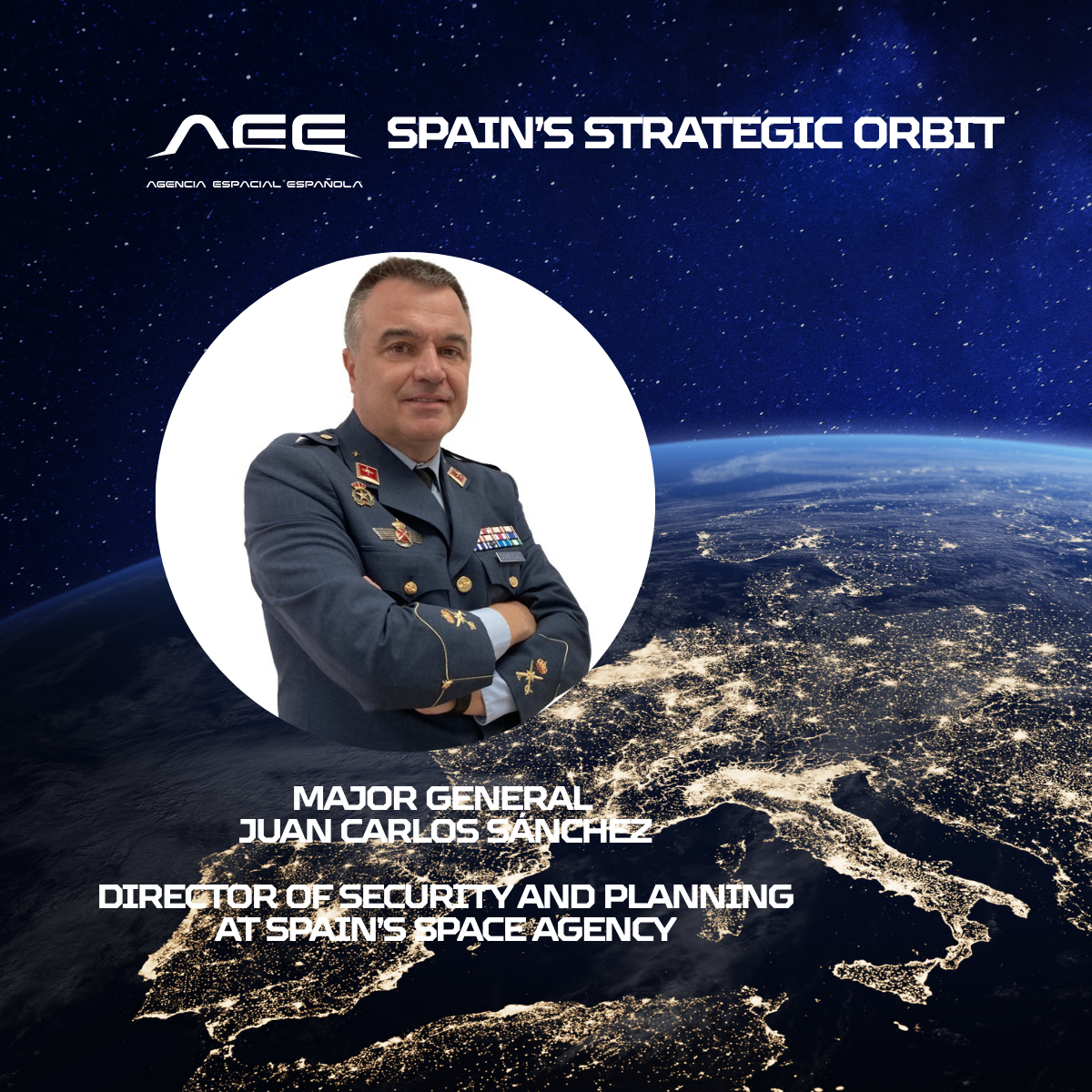
To better understand AEE's mission, impact, and possibilities of collaboration we spoke with Major General Juan Carlos Sánchez, Director of Security and Planning at the Agency.
How is the creation of the Spanish Space Agency (AEE) reconfiguring Spain's role in the global and European space ecosystem, and what does this mean for the country's technological sovereignty?
The creation of the Spanish Space Agency (AEE) reconfigures Spain's role by centralizing the strategic direction of the sector (previously dispersed across 17 ministries) and acting as a single voice to consolidate an already robust industrial and scientific ecosystem.
This reinforces the country's technological sovereignty through a strategy articulated around three fundamental axes:
Develop Sovereign Capabilities: Ensuring that Spain has its own means for critical services, such as secure communications (e.g., Spainsat NG satellite) or space surveillance (SST).
Achieve Autonomous Access to Space: Supporting the development of national launchers, such as the Miura 5, by considering the capability to launch its own satellites as non-negotiable for real autonomy.
Promote Leadership in R&D&I and Science: Coordinating universities and companies to lead scientific programs. This translates into industrial milestones (such as being the prime contractor for ESA on the CHEOPS mission) and scientific ones (such as leading a complete ESA mission for the first time: Arrakhis).
In summary, Spanish technological sovereignty and European strategic autonomy are mutually reinforcing. By developing its own capabilities in critical technologies (like Spainsat NG or SST) so as not to depend on third parties, Spain contributes directly to a more resilient Europe. In turn, European autonomy strengthens Spain's sovereignty.
How is the AEE integrating cybersecurity, artificial intelligence (AI), and emerging technologies to strengthen space security and resilience against evolving threats?
The AEE considers AI, cybersecurity, and quantum technologies as absolute priorities, as they reconfigure defense and security, allowing Spain to develop the next generation of dual-use (civil and military) space services.
The integration of these technologies is key:
Artificial Intelligence (AI) is considered essential for managing the vast amount of data collected by satellites, for both security and civil applications.
Secure communications are vital for government and defense, such as those that will be used by the Spainsat NG satellite.
Quantum Key Distribution (QKD) is an emerging technology that Spain is already working on, with projects like Caramuel, seeking to create *unhackable communications*.
To strengthen security and resilience structurally, the AEE has a dual nature, reporting to both the Ministry of Science, Innovation and Universities and the Ministry of Defence. This is reflected in the creation of a Directorate of Security and Planning within the Agency, headed by a General from the Air and Space Force.
The function of this directorate is to contribute to the objectives set by the national Security and Aerospace Security Strategy, as well as the European Union's Space Strategy for Security and Defence and NATO's Space Policy. It must also support tasks related to the certification of space infrastructures, ensure cybersecurity, protect information, accredit companies, facilities, and personnel participating in classified projects, and protect against threats and risks.
Furthermore, Spain is taking on a European leadership role in resilience. The AEE coordinates the European Union's Space Surveillance and Tracking (EU SST) program. This system, supported by the advanced national S3T system (considered one of the most advanced in the world), functions as Europe's first line of defense in space, detecting risks such as collisions with space debris, analyzing re-entries, detecting interference, and preparing for the effects of space weather.
How is Spain fostering collaboration — both in Europe and with academia and industry — to develop the next generation of talent in the space and cybersecurity sectors?
Spain fosters collaboration and talent through a multifaceted strategy, as collaboration is in the AEE's DNA.
At the international level, Spain combines a leadership role in European programs, such as at ESA (being the fifth-largest contributor), with the promotion of bilateral agreements (with partners like Portugal) and multilateral ones (with NASA or the Latin American agency ALCE).
At the national level, collaboration between academia and industry is a fundamental pillar. The AEE acts as a bridge and a catalyst to connect these two worlds: research generates ideas and talent, and industry turns those ideas into concrete solutions. The goal is to promote technology transfer from universities and research centers to the industrial fabric, especially to SMEs and startups.
To materialize this collaboration and foster talent, concrete tools are being used. A clear example is the network of ESA Business Incubation Centres (ESA BIC). This network is the main support element for New Space entrepreneurship. Spain already has five of these centers and plans to expand to eight. These incubators help startups mature by connecting innovation (academia and entrepreneurs) with industry needs, and offering them technical support, mentoring, and funding (up to 60,000 euros per project).
To develop the next generation of talent, especially in cybersecurity, events like the Space Cybersecurity Hackathon are a very valuable tool. These events serve for training and talent detection, connecting young people with the real challenges of the sector. Furthermore, the AEE's Space and Society Office promotes outreach and education to foster STEM vocations from an early age. The ultimate goal is to build a future workforce that combines technical knowledge with a commitment to security."
Author: Tatiana Skydan, Co-Founder at THE SIGN.MEDIA
Source:
Photo: