
Patrick Trinkler: Space Is Becoming the Cloud – Is Europe Ready to Secure It?
CYSEC and CYSAT co-founder Patrick Trinkler explains why satellites are turning into cloud infrastructure, and why Europe's cybersecurity problem is really an investment problem.
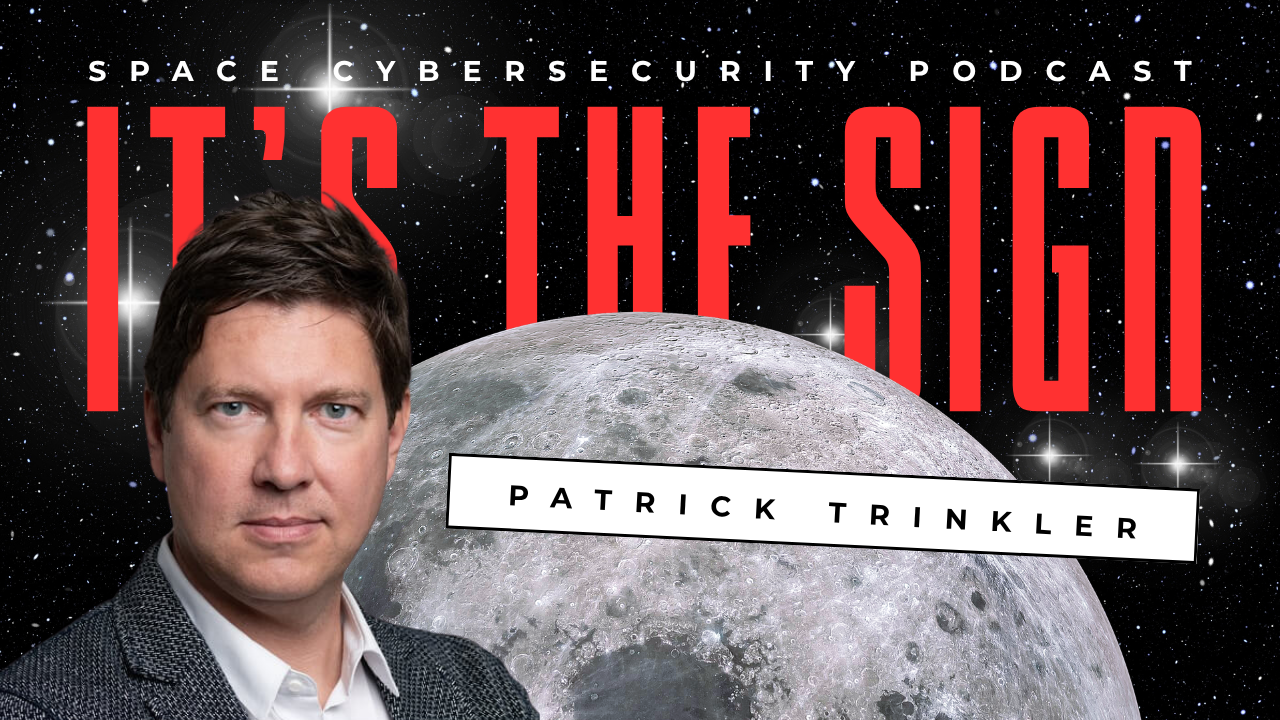
From Quantum Cryptography to Space Cyber
Patrick Trinkler has spent his career a step ahead of infrastructure everyone else was still building. In the early 2000s he co-founded ID Quantique, a University of Geneva spinoff, with Yacine Felk, betting on quantum cryptography years before the market had a name for it.
"The ecosystem was not ready for that," he told IT'S THE SIGN. It took nearly two decades for quantum security to become the crowded field it is today, and it grew up mostly in Asia rather than Europe.
When ID Quantique exited in 2018, Trinkler and Felk didn't stop. They founded CYSEC, a Swiss company now operating across Switzerland, France and Luxembourg, on a similar bet: that space infrastructure was about to go through the same shift the internet went through twenty years earlier, from closed operational systems to open, cloud-like networks.
"We have this move in space from operational technology to information technology," Trinkler said, pointing to SpaceX's Starlink as the clearest example.
Once satellites start behaving like cloud infrastructure, he argues, they need the same protections the cloud has: encryption for data moving between ground stations and satellites, for data sitting on board, and for data while it's actively being processed, plus a layer of sovereign control over who can access all three. CYSEC's ARCA Trusted OS is built to bring that kind of confidential computing into orbit, including early work on the idea of a full data centre in space.
Building an Ecosystem, Not Just a Product
A startup can't build a market on its own, Trinkler says, and that's why he founded CYSAT alongside CYSEC. He'd run this playbook once before: growing the quantum-security market at ID Quantique meant investing in training and events long before the technology was mainstream.
CYSAT launched in Paris in 2021 as a small, focused gathering. Two years later, a live satellite-hacking demonstration on ESA's OPS-SAT put it on the map and drew more than 450 specialists.
By 2025, at Station F in Paris, it had grown to nearly 600 attendees and 60-plus speakers, with ESA's director general on stage. The event now runs chapters in Toulouse, Warsaw, Colorado Springs and Washington DC, added Singapore in 2026, and will hold its first Spanish edition in Madrid on 28 October, before returning to Paris in 2027.
Risk Looks Different by Region
Trinkler frames cybersecurity as insurance. How much of it an organization buys depends on how it perceives risk, and that perception is cultural as much as technical. Europe's instinct, he says, leans toward mitigation through proven, conventional tools rather than untested innovation. Asia tends to do the opposite, reaching for new technology to manage new risk.
The US backs its bets with far more venture capital, which lets private companies build infrastructure that in Europe usually needs public institutional support, and that support, spread across many nations and administrations, tends to arrive slowly.
None of this makes the challenge any less global. Space, by design, connects regions that otherwise operate on different assumptions about risk. That's exactly why an event like CYSAT needs to keep pulling people from all of them into the same room.
Sovereignty Between Two Blocks
Much of the conversation turned to geopolitics. Trinkler sees Europe positioned between an increasingly entrenched US-China rivalry, with the war in Ukraine as one of its clearest collateral effects on European strategic thinking. He pointed to a stretch earlier this year when European access to some US AI tools, including models from Anthropic, was restricted, as a live example of why he believes Europe needs its own sovereign technology stack for satellites and AI rather than dependence on either bloc.
Launch costs are part of the same story, in his view. The US solved its cost problem years ago with reusable rockets, and Trinkler argues China is closing that same gap. Europe, still relying on Ariane 6, hasn't caught up. ESA's own leadership has said publicly that the agency needs reusable launch capability to stay competitive, a concern Trinkler shares.
Why Regulation Isn't the Real Bottleneck
With NIS2, the Cyber Resilience Act and early talks of an EU Space Act all moving through Brussels, Trinkler doesn't think Europe is missing a rulebook. Regulation, in his view, is supposed to arrive after a technology is adopted, as a way to raise quality once a use case has proven itself, not before it. Rules add administrative weight and compliance cost. For companies that can absorb it, meeting a new standard is simply the price of improving.
What worries him more is the investment gap sitting behind the regulation. He points to Palantir, founded in 2003, as an example of what patient capital can build over two decades: the data-analytics company didn't turn cash-flow positive until 2023, and few European companies have had that kind of runway. Building a European equivalent for satellite data, in his reading, is less a technology problem than a funding one.
Closing the Talent Gap With Community
On skills, Trinkler pushes back gently on the idea that Europe simply lacks qualified people. What's missing, he argues, is exposure. Students need contact with the processes used by established players like Thales and Leonardo, and the chance to build something of their own early, whether that's a startup, an open-source project or a hackathon team, before a career in space cybersecurity starts to feel out of reach.
That's the thinking behind CYSAT Academy and CYSAT's innovation corner, which put students and young engineers in the same room as the ecosystem they might one day join. It's also, he admits, how CYSEC competes for talent against companies in the US and China that can simply pay more: not on salary, but on the chance to help build something new.
Conclusion
CYSAT reconvenes in Madrid on 28 October, the next test of whether Europe's space cybersecurity community can turn its ecosystem into real capacity.
Listen & watch the full episode:
- YouTube
- Spotify
Interviewer: Margaux Lucas — Margaux Lucas, MC at CYSAT and Doctoral Candidate & Teaching Fellow in Political Science, Sciences Po Strasbourg / University of Strasbourg.
Producer: Tatiana Skydan — co-founder & editor-in-chief at THE SIGN.MEDIA